


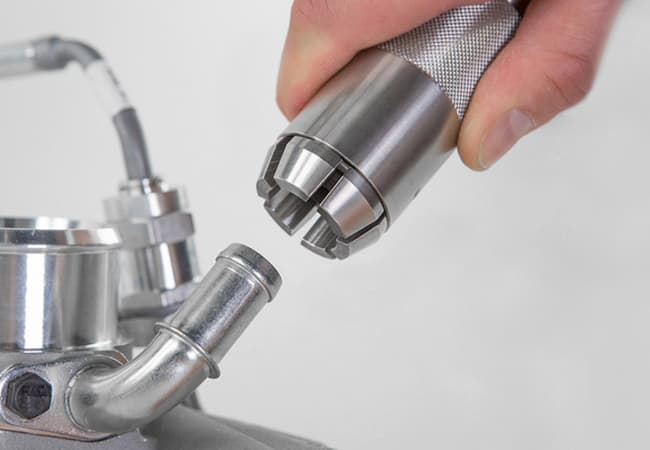

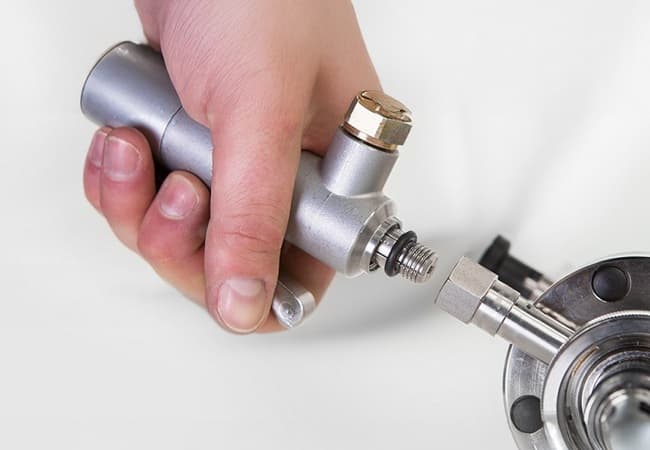





Why use quick connectors for filling?
Manual screwing takes time and increases the risk of injuries, leaks, and damage to valves or connectors. Especially during frequent filling processes, efficiency is key.
The solution: WEH® Quick Connectors
- Connection in seconds
- Equipped with various safety features
- Available for all connection standards and thread types
- Manufactured from high-quality materials
- Time and cost savings
- Enhanced productivity
- Protection of operators’ joints

Quick connect without hand-tightening
Tool-free handling saves time, reduces downtime, and increases process speed.

Maximum safety
Integrated safety features such as locking mechanisms, pressure relief, or protective guards prevent misuse and protect both personnel and equipment.

Tested leak-tightness & reliability
Flow-optimized design, durable sealing systems and 100% final inspection ensure permanently leak-free connections.

Wide Range of Connection Options
Available for nearly all thread types, valve connections, and country-specific standards – or as fully customized solutions.

Robust quality – Made in Germany
High-quality materials, wear-resistant design and sophisticated technology for thousands of cycles in tough continuous use.
The right quick connector for every application.
WEH® Connectors cover a wide range of connection standards – from standardized threads to individual connection shapes.

Manufacturing








Operating Pressure:
Vacuum up to max. 350 bar
Actuations:
H = manual actuation via hand lever
V = pneumatic actuation via valve button
P = pneumatic actuation for external manual, semi or fully
automatic control systems

Operating Pressure:
Vacuum up to max. 350 bar
Actuation:
Manual actuation via clamping lever

Operating Pressure:
5 - 12 bar compressed air
Actuation:
Manual actuation via sliding sleeve

Operating Pressure:
Vacuum up to max. 345 bar
Actuation:
Hand-tightening

Operating Pressure:
Vacuum up to max. 9 bar
Pilot pressure:
Body size 01: 6 - 9 bar compressed air
Body size 1 - 8: 6 - 12 bar compressed air
Actuation:
Pneumatic actuation

Operating Pressure:
Vacuum up to max. 35 bar
Pilot pressure:
6 - 12 bar compressed air
Actuation:
Pneumatic actuation

Operating Pressure:
Vacuum up to max. 50 bar
Actuation:
Hand-tightening

Operating Pressure:
Vacuum up to max. 50 bar
Actuation:
Manual actuation via sliding sleeve

Operating Pressure:
Vacuum up to max. 630 bar
Actuation:
Manual actuation via sliding sleeve

Operating Pressure:
Vacuum up to max. 350 bar
Actuations:
H = manual actuation via hand lever
V = pneumatic actuation via valve button
P = pneumatic actuation for external manual, semi or fully
automatic control systems
Operating Pressure:
Vacuum up to max. 9 bar
Pilot pressure:
Body size 01: 6 - 9 bar compressed air
Body size 1 - 8: 6 - 12 bar compressed air
Actuation:
Pneumatic actuation
Operating Pressure:
Vacuum up to max. 35 bar
Pilot pressure:
6 - 12 bar compressed air
Actuation:
Pneumatic actuation

Operating Pressure:
Max. 3 bar
Actuation:
Manual actuation via clamping lever

Operating Pressure:
Vacuum up to max. 70 bar
Actuation:
Manual actuation via clamping lever

Operating Pressure:
Vakuum bis max. 100 bar
Actuation:
Manual actuation via hand lever

Operating Pressure:
Vacuum up to max. 70 bar
Actuation:
Manual actuation via clamping lever
Operating Pressure:
Max. 3 bar
Actuation:
Manual actuation via clamping lever
Operating Pressure:
Vacuum up to max. 70 bar
Actuation:
Manual actuation via clamping lever
Operating Pressure:
Vacuum up to max. 9 bar
Pilot pressure:
Body size 01: 6 - 9 bar compressed air
Body size 1 - 8: 6 - 12 bar compressed air
Actuation:
Pneumatic actuation
Operating Pressure:
Vacuum up to max. 9 bar
Pilot pressure:
Body size 01: 6 - 9 bar compressed air
Body size 1 - 8: 6 - 12 bar compressed air
Actuation:
Pneumatic actuation
Operating Pressure:
Vacuum up to max. 35 bar
Pilot pressure:
6 - 12 bar compressed air
Actuation:
Pneumatic actuation
Operating Pressure:
Max. 3 bar
Actuation:
Manual actuation via clamping lever
Operating Pressure:
Vacuum up to max. 70 bar
Actuation:
Manual actuation via clamping lever
Operating Pressure:
Vacuum up to max. 350 bar
Actuations:
H = manual actuation via hand lever
V = pneumatic actuation via valve button
P = pneumatic actuation for external manual, semi or fully
automatic control systems
Operating Pressure:
Vacuum up to max. 9 bar
Pilot pressure:
Body size 01: 6 - 9 bar compressed air
Body size 1 - 8: 6 - 12 bar compressed air
Actuation:
Pneumatic actuation
Operating Pressure:
Vacuum up to max. 35 bar
Pilot pressure:
6 - 12 bar compressed air
Actuation:
Pneumatic actuation
Operating Pressure:
Vacuum up to max. 50 bar
Actuation:
Manual actuation via sliding sleeve
Operating Pressure:
Vacuum up to max. 630 bar
Actuation:
Manual actuation via sliding sleeve
Operating Pressure:
Vacuum up to max. 350 bar
Actuations:
H = manual actuation via hand lever
V = pneumatic actuation via valve button
P = pneumatic actuation for external manual, semi or fully
automatic control systems
Operating Pressure:
Vacuum up to max. 9 bar
Pilot pressure:
Body size 01: 6 - 9 bar compressed air
Body size 1 - 8: 6 - 12 bar compressed air
Actuation:
Pneumatic actuation
Operating Pressure:
Vacuum up to max. 35 bar
Pilot pressure:
6 - 12 bar compressed air
Actuation:
Pneumatic actuation
Operating Pressure:
Max. 3 bar
Actuation:
Manual actuation via clamping lever
Operating Pressure:
Vacuum up to max. 70 bar
Actuation:
Manual actuation via clamping lever
Operating Pressure:
Vacuum up to max. 350 bar
Actuations:
H = manual actuation via hand lever
V = pneumatic actuation via valve button
P = pneumatic actuation for external manual, semi or fully
automatic control systems
Operating Pressure:
Vacuum up to max. 9 bar
Pilot pressure:
Body size 01: 6 - 9 bar compressed air
Body size 1 - 8: 6 - 12 bar compressed air
Actuation:
Pneumatic actuation
Operating Pressure:
Vacuum up to max. 35 bar
Pilot pressure:
6 - 12 bar compressed air
Actuation:
Pneumatic actuation
Operating Pressure:
Max. 3 bar
Actuation:
Manual actuation via clamping lever
Operating Pressure:
Vacuum up to max. 70 bar
Actuation:
Manual actuation via clamping lever
Operating Pressure:
Vacuum up to max. 350 bar
Actuations:
H = manual actuation via hand lever
V = pneumatic actuation via valve button
P = pneumatic actuation for external manual, semi or fully
automatic control systems

Gas Industry


Max. allowable operating pressure PS:
250 bar
Media:
Medical oxygen
Actuation:
Manual actuation via operating loop

Max. allowable operating pressure PS:
250 bar | 375 bar
Media:
Oxygen, nitrogen, C02, air, inert gases, medical gases
Actuation:
Manual actuation via operating loop

Max. allowable operating pressure PS:
250 bar
Media:
Medical oxygen
Actuation:
Manual actuation via operating loop

Max. allowable operating pressure PS:
250 bar
Media:
Medical oxygen
Actuation:
Manual actuation via sliding sleeve

Max. allowable operating pressure PS:
250 bar
150 bar with TVCO2 linear valve
Media:
CO2, refrigerants
Actuation:
Manual actuation via grip sleeve

Max. allowable operating pressure PS:
30 bar
Media:
Propane, butane
Actuation:
Manual actuation via sliding sleeve (pneumatically supported)
Connects to:
DIN 477 part 1 no. 1 and 2

Max. allowable operating pressure PS:
250 bar | 375 bar
Media:
Inert/flammable gases, oxygen, argon, nitrogen
Actuation:
Manual actuation via grip sleeve
Max. allowable operating pressure PS:
250 bar
Media:
Medical oxygen
Actuation:
Manual actuation via clamping lever

Max. allowable operating pressure PS:
250 bar
Media:
Medical oxygen
Actuation:
Manual actuation via clamping lever

Breathing Air
For Breathing Air (BA) filling rigs

Max. allowable operating pressure PS:
250 bar | 375 bar
Media:
Breathing air (compressed air)
For Breathing Air (BA) hose filling systems
Max. allowable operating pressure PS:
250 bar | 375 bar
Media:
Breathing air (compressed air)

HVAC-R

Refrigerants:
R134A, R22 or R410A
Operating pressure PS:
Max. 42 bar
Refrigerants:
R134A, R22 or R410A
Operating pressure PS:
Max. 250 bar
Max. 150 bar (with TVCO2 linear valve)

Media:
Refrigerant R134A, R22 or R410A
Operating pressure PS:
Max. 40 bar
Straight tubes (outer-Ø)
Sealing range:
6,00 - 22,2 mm OD
Operating pressure PS:
Max. 100 bar
Sealing range:
6.00 - 22.2 mm OD
Operating pressure PS:
Max. 70 bar
Straight tubes (inner-Ø)
Sealing range:
9.5 - 24.4 mm ID
Operating pressure PS:
Max. 3 bar
Sealing range:
9.5 - 22.2 mm ID
Operating pressure PS:
Max. 70 bar
Sealing range:
9.5 - 24.4 mm ID
Operating pressure PS:
Max. 3 bar
Sealing range:
9.5 - 22.2 mm ID
Operating pressure PS:
Max. 70 bar
Sealing range:
9.5 - 24.4 mm ID
Operating pressure PS:
Max. 3 bar

Filling and evacuating refrigerants in automotive air conditioning equipment during production.
Operating pressure PS:
Max. 35 bar

Reasonably priced alternative to the TW110. The TW108 is suited for filling and evacuating refrigerants during maintenance.
Operating pressure PS:
Max. 35 bar
Sealing range:
9.5 - 24.4 mm ID
Operating pressure PS:
Max. 3 bar
Sealing range:
9.5 - 22.2 mm ID
Operating pressure PS:
Max. 70 bar
Types of actuation for cylinder filling.
A large variety of actuations (operating loops, wire ropes, levers etc.) for different cylinder sizes are available and enable cylinder filling with and without safety caps.

Rigid operating loops
Great loop
For Cylinders with cap
Operating lever
Operating loop
With flexible wire rope and locking device

Manual actuation
With sliding sleeve
Pneumatic actuation
For external manual, semi or fully automatic control systems
Pneumatic actuation
Via valve button
Manual actuation
Via hand lever
Manual actuation
Via Clamping lever
Types of actuation for filling configurations.
Whether manually via lever or sliding sleeve – or automated via pneumatic actuation: Our quick connectors are available in numerous actuation variants and can be flexibly integrated into existing processes.

Special connection? Unique requirement?
Typical Applications

Filling / evacuating of technical gases
Whether argon, CO₂ or nitrogen – with WEH® quick connectors you can fill and evacuate gas cylinders quickly, safely and completely without screwing.
Filling / evacuating breathing air & oxygen
Quick, safe and without risk to the valve or operator – WEH® quick connectors for firefighting, diving and medical technology.
Evacuating the refrigerant circuit
Before filling air conditioning systems & refrigeration circuits, complete evacuation is mandatory. With WEH® quick connectors, this can be done safely, cleanly and without screws – ideal for workshops and series production.

Filling of H2 tanks
Efficient and safe: With WEH® quick connectors, you can reliably fill hydrogen containers (e.g., H2 trailers) – ideal for research, industry, and mobility.


Discover & Download
Downloads
Catalogs
Get a quick overview of the entire range of WEH products - clear, compact and as a PDF for download.
Operating Instructions
All information on the safe commissioning and use of our products - including safety instructions and step-by-step instructions.
Certificates
Our products are tested and certified according to international standards. Here you will find all relevant quality and conformity certificates.
Why WEH?

Quality You Can Rely On
Our products are manufactured to the highest standards. At WEH, quality is no coincidence – it’s our standard, ensured by 100% final inspection and certified processes.

Service You Can Rely On
By choosing a WEH® product, you’ve chosen long-lasting quality. And our service ensures it stays that way. Whether maintenance, inspection, repair, or original spare parts – our experienced team is committed to maximum safety, efficiency, and preserving the value of your equipment.

Fast and Helpful Support
Questions about application, technology, or spare parts? Our technical support team is here for you – direct, competent, and without detours. Personally available and globally reliable.